(872) 316-6769

Commercial tile installation in Chicago, IL

Commercial tile work has to fit the way a space operates. We plan installation around access, business hours, adjacent trades, cleaning routines, and the demands placed on each surface. The work begins with a site review and an installation plan, then proceeds with careful preparation, controlled sequencing, and a clear handoff.

(872) 316-6769
Two taupe styling chairs reflected on a glossy white floor with broad gray and warm beige veining.

A tile plan that respects the working day

A storefront, office, lobby, corridor, restroom, or service area may need to stay partly usable while work proceeds. We discuss entrances, deliveries, furniture, dust control, occupant routes, and the order of rooms before tile is ordered. Where an area must be closed, the schedule should reflect adhesive and grout cure times rather than a hopeful shortcut.

Material selection follows the surface and the maintenance routine. Porcelain can suit demanding floors, ceramic may work well on appropriate walls, and mosaics can help with transitions or smaller areas. Large-format tile may reduce grout lines but requires a suitably flat substrate and deliberate handling. Stone needs a compatible setting system and a care plan that respects its porosity.

From the first measure
to the last joint

A good finish begins before the first tile.

1. Review the space and schedule

We walk the work area, note entrances, elevators, loading access, occupied zones, existing finishes, and nearby operations. We ask how the space is cleaned, where traffic concentrates, and whether work must be phased by room or by shift. That information shapes the sequence, protection plan, material staging, and realistic return-to-use discussion.
2. Confirm substrate and conditions

Tile needs a sound, clean, and suitably flat base. We check for loose material, cracks, contamination, moisture concerns, uneven transitions, and movement or deflection that could affect the finished installation. Concrete, wood-based assemblies, existing tile, and other substrates call for different preparation. Any repair, leveling, or specialty treatment is considered against the project conditions and product instructions.

3. Coordinate layout and materials

Before setting begins, we review tile size, pattern, grout joints, edge details, thresholds, drains, door clearances, and visible starting points. We account for batch, shade, caliber, and dye-lot differences where applicable. Tile, mortar, grout, membranes, primers, sealers, and transition pieces must be compatible as a system. The plan also considers cuts at corners and fixtures so prominent sightlines remain composed.

4. Set, grout, and protect

We install over the prepared surface using the selected setting method and the manufacturer’s requirements. Coverage matters: the mortar transfer should support the tile for its use, with extra attention at edges and corners on floors subject to rolling loads or concentrated traffic. We keep joints consistent, respect movement joints, and protect finished areas from premature traffic, dust, moisture, and other trades while materials cure.

5. Walk through the handoff

At completion, we review transitions, edges, grout, fixtures, access routes, and areas that need additional cure time. We remove installation residue using methods appropriate to the tile and grout, then explain routine cleaning and any stone-care precautions. A final walkthrough gives the owner or manager a chance to identify open items before the space returns to its normal cleaning and occupancy pattern.

Materials and surfaces
we work with

Tile, setting materials, and substrate need to work as one system.

Ceramic

Ceramic tile can be a practical choice for suitable commercial walls and lighter-use areas. We confirm the product’s intended application, water exposure, size, finish, and cleaning requirements before pairing it with mortar and grout.

Porcelain

Porcelain is often considered for floors and other surfaces that need a dense, durable tile, but the exact product still governs placement. We review slip characteristics, finish, format, joint design, and cleaning conditions rather than treating every porcelain tile alike.

Large-format porcelain

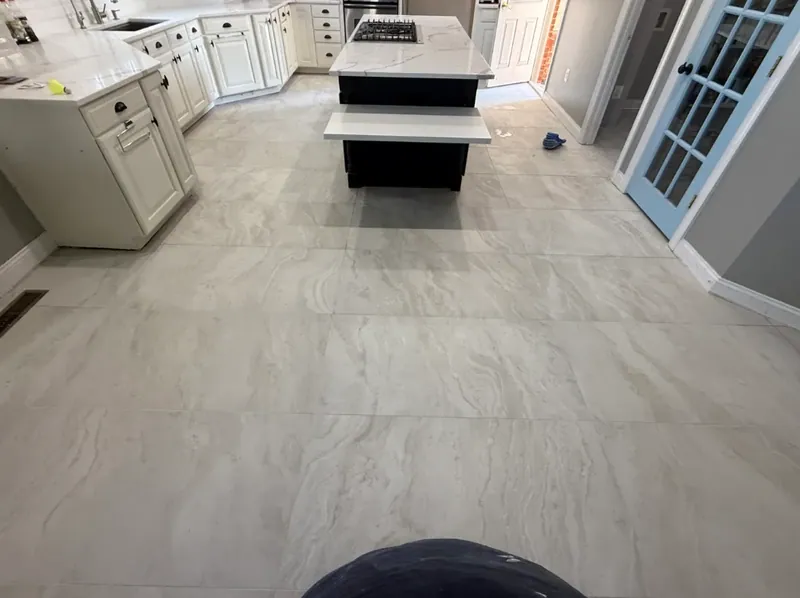
Large-format porcelain can create a quieter visual field with fewer grout lines. It also demands a flatter substrate, careful mortar coverage, appropriate handling, and a layout that accounts for lippage, movement, cuts, and access to the setting area.

Natural stone

Stone varies in absorption, strength, surface texture, and reaction to cleaners. We assess the specific material, select compatible setting products, and discuss sealing and maintenance where appropriate. Stone care is part of the installation conversation, not an afterthought.

Mosaic

Mosaic sheets can help with curves, borders, feature areas, and floors that benefit from frequent grout joints. We check sheet alignment, joint continuity, backing, coverage, and transitions so the pattern does not drift across a visible commercial area.

Glass

Glass tile has specific requirements for mortar color, coverage, movement, and sometimes translucency. We verify the product guidance before installation and pay close attention to substrate uniformity, edge treatment, and cleaning methods that will not scratch the surface.

Planning for access, traffic, and cleaning

Commercial installation is also an operations exercise. We can plan a staged sequence for an office corridor, storefront entry, restroom group, reception area, or other defined zone, subject to the site’s access and occupancy needs. The plan should identify where tools and materials can be placed, how people move around the work, and which surfaces need temporary protection. It should also leave room for required cure times and inspections by the owner, designer, or other trades.

A finished floor may encounter carts, chair casters, tracked-in grit, cleaning equipment, and repeated wet cleaning. Those conditions inform tile finish, grout selection, joint layout, transitions, and maintenance discussion. Winter salt and grit can be especially abrasive at entries, so entry protection deserve attention. The approach depends on the selected products, traffic, substrate, and facility routine.

Preparation is part of the finish

Uneven or moving substrates can telegraph through tile, interrupt drainage, and contribute to cracked grout or loose edges. We look for the causes of an uneven base rather than covering them with tile. Flatness tolerances, deflection, moisture, bond, and movement-joint requirements are evaluated in relation to tile size and the setting system. If conditions call for leveling, crack-isolation treatment, underlayment, or a different installation detail, that work is discussed before the setting phase.

Existing commercial spaces can contain layers of old flooring, adhesive, patching compound, or unknown materials. Removal methods and disposal should account for the building and the material being disturbed. Where hazardous material may be present, a qualified assessment is appropriate before removal begins. We do not treat an uncertain substrate as ready simply because it looks clean at a glance.

A practical maintenance handoff

Use the cleaning products and dwell times recommended for the installed tile, grout, and any sealer. Remove abrasive grit at entries, use non-scratching tools, and avoid acidic or aggressive cleaners unless the product maker specifically allows them. Stone may need a different routine from porcelain, and a textured floor may need different equipment from a smooth wall. Ask the facility’s cleaning team to review the care instructions before the first regular service.

Keep heavy traffic, rolling loads, and wet cleaning off newly installed areas until the mortar and grout have reached the time specified for the products and site conditions. Document changes and contact the project team before applying an unapproved patch or cleaner.

What shapes the estimate

Commercial tile pricing depends on the measured area, tile format, substrate condition, removal, leveling, access, phasing, protection, transitions, and the setting materials required. A site review is the useful starting point because a square-foot figure alone cannot describe preparation or operating constraints. Material selections and installation details should be confirmed before a scope is finalized.

Share the space type, approximate areas, tile or finish you are considering, desired timing, and any access or occupancy limits. We can discuss what needs to be reviewed and details that may affect the work plan. Any proposal should distinguish installation, preparation, removal, materials, protection, and other approved scope items clearly.

Where we work

Map of the ten towns we serve around River Forest, ILRiver ForestHome baseOak ParkForest ParkBerwynCicero

River Forest is our home base. Point at a town to see how far it is.

Based in River Forest. Working in the homes and everyday spaces of Chicago’s western neighborhoods and suburbs.

Good questions

Can you work around an occupied storefront or office?

We can discuss phased work, access routes, protection, and scheduling around operations. The workable sequence depends on the space, other trades, cure times, and the owner’s requirements.

What commercial areas do you install?

We discuss storefronts, offices, entries, corridors, lobbies, restrooms, and other areas where tile is an appropriate finish. The site review confirms substrate, use, access, and installation details.

How do you choose tile for a high-traffic floor?

We consider the product’s intended use, finish, slip characteristics, format, grout joints, cleaning routine, traffic, and rolling loads. Product data and site conditions guide the selection rather than a material label alone.

Do large-format tiles need special preparation?

Usually, yes. Large-format tile places greater demands on substrate flatness, handling, mortar coverage, layout, and lippage control. The required preparation depends on tile dimensions, substrate, and the manufacturer’s instructions.

Can you install over existing commercial tile?

Sometimes, if the existing assembly is sound, well bonded, clean, suitably flat, and compatible with the proposed system. Removal may be the better path when layers are loose, contaminated, damaged, or too uneven.

How soon can a commercial area reopen?

Reopening depends on the mortar, grout, sealer, temperature, moisture, traffic, and product instructions, and protection removal. We discuss a practical return-to-use sequence after reviewing the installation.

A good finish starts with a conversation.

Tell us about the room, the tile, and what you have in mind.

(872) 316-6769